
Quantum Computing Market Size and Forecast: Unlocking Trillion-Dollar Potential
The dawn of the quantum era is upon us, heralding a transformative shift in computational power that promises to reshape industries from finance and healthcare to logistics and cybersecurity. Understanding the quantum computing market size and forecast is crucial for businesses, investors, and policymakers aiming to navigate this complex yet incredibly promising landscape. This comprehensive guide delves into the current valuation, projected growth, and critical factors influencing the trajectory of quantum technology, providing unparalleled insights for those looking to capitalize on its immense potential. Prepare to explore a market on the cusp of exponential expansion, driven by breakthroughs in quantum hardware, innovative quantum software, and a growing recognition of its strategic importance.
The Genesis of a New Computational Frontier
Quantum computing represents a paradigm shift from classical computing, leveraging the principles of quantum mechanics—superposition, entanglement, and interference—to process information in fundamentally new ways. Unlike traditional bits, which are either 0 or 1, quantum bits, or qubits, can exist in multiple states simultaneously, enabling vastly more complex calculations and the potential to solve problems currently intractable for even the most powerful supercomputers. This inherent capability underpins the burgeoning interest and investment in the sector, positioning it as a key pillar of future technological advancement. The commercialization of quantum computing, though still in its nascent stages, is accelerating rapidly, moving from theoretical possibility to tangible applications.
Key Drivers Fueling Quantum Market Growth
Several significant factors are propelling the expansion of the quantum computing market. Recognizing these drivers is essential for accurately assessing the market's future trajectory:
- Government Funding and Initiatives: Major global powers like the US, China, the EU, and the UK are investing billions in quantum research and development, viewing it as a matter of national security and economic competitiveness. These investments often fund university research, national labs, and even private sector partnerships, accelerating innovation.
- Increasing R&D Investments by Tech Giants: Companies such as IBM, Google, Microsoft, Amazon, and Honeywell are pouring substantial resources into developing their own quantum computing platforms, competing fiercely to achieve quantum supremacy and establish market leadership. Their efforts are crucial for both hardware and quantum algorithms development.
- Growing Demand for High-Performance Computing: Industries are facing problems that conventional computers cannot efficiently solve, such as drug discovery, materials science, financial modeling, and complex optimization. Quantum computing offers a pathway to tackle these "intractable" challenges, driving demand from early adopters.
- Advancements in Quantum Hardware and Software: Continuous breakthroughs in qubit stability, error correction, and the development of more robust quantum programming languages and platforms are making quantum systems more accessible and reliable, moving them closer to commercial viability.
- Emergence of Cloud Quantum Computing: Platforms offering quantum computing as a service (QCaaS) are democratizing access to quantum resources, allowing a broader range of businesses and researchers to experiment with and develop quantum applications without significant upfront investment in hardware.
Sizing Up the Quantum Computing Market: Current Valuations and Projections
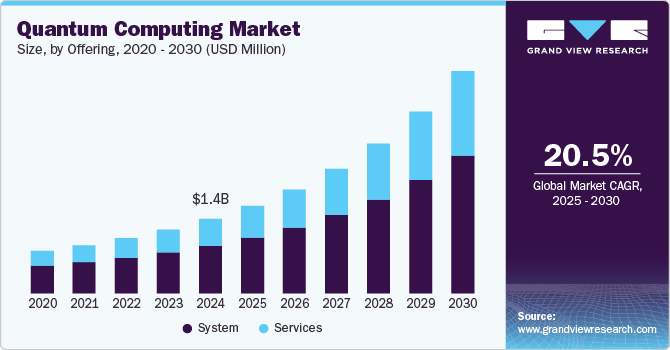
Estimating the precise quantum computing market size is challenging due to its early stage and rapid evolution. However, various market research reports provide compelling forecasts that illustrate its explosive potential. In recent years, the market has been valued in the hundreds of millions of dollars, with projections indicating a multi-billion-dollar valuation within the next few years, potentially reaching tens of billions by the end of the decade.
Projected Growth and Future Forecasts
Analysts widely anticipate a compound annual growth rate (CAGR) exceeding 30%, and in some optimistic scenarios, even 50% or more, over the next five to ten years. This aggressive growth is predicated on the increasing maturity of quantum technologies and the expansion of their practical applications. By 2030, some forecasts suggest the market could approach
- Short-Term (2024-2026): Focus on R&D, pilot projects, and specialized applications in finance, pharma, and defense. Market growth driven by infrastructure development and proof-of-concept initiatives.
- Mid-Term (2027-2032): Increased commercialization, wider adoption of cloud-based quantum services, and the emergence of industry-specific quantum software solutions. Early competitive advantages for companies leveraging quantum.
- Long-Term (2033+): Maturation of quantum error correction, development of fault-tolerant quantum computers, and integration of quantum capabilities into mainstream computing, leading to widespread disruption and new market creation.
Segmentation of the Quantum Computing Market
The quantum computing market can be broadly segmented based on its components, end-use industries, and deployment models. Understanding these segments provides a clearer picture of where investment and innovation are concentrated.
By Component
- Quantum Hardware: This segment includes the physical quantum processors (based on superconducting qubits, trapped ions, photonic, topological, etc.), refrigeration systems, control electronics, and associated infrastructure. Hardware development is capital-intensive and requires significant scientific breakthroughs.
- Quantum Software: Encompasses quantum operating systems, development kits (SDKs), programming languages, quantum algorithms, and application-specific software layers. This is a rapidly evolving area, crucial for making quantum hardware usable and accessible.
- Quantum Services: Includes consulting, implementation, training, maintenance, and quantum computing as a service (QCaaS). This segment is vital for enabling businesses to integrate quantum solutions without developing in-house expertise.
By End-Use Industry
While quantum computing holds promise for nearly every sector, some industries are poised for earlier and more significant impact:
- Healthcare & Pharmaceuticals: Drug discovery, personalized medicine, protein folding, and genomics. Quantum chemistry simulations can vastly accelerate the development of new treatments.
- Finance & Banking: Portfolio optimization, fraud detection, risk analysis, high-frequency trading, and post-quantum cryptography to secure transactions against future quantum attacks.
- Automotive & Transportation: Logistics optimization, autonomous vehicle development, and new materials design for batteries and lightweight components.
- Defense & Government: Cryptography, intelligence analysis, secure communications, and advanced material science for defense applications.
- Chemical & Materials: Designing new materials with specific properties, catalysis optimization, and understanding complex molecular interactions.
- Manufacturing: Supply chain optimization, factory automation, and design of new industrial processes.
Challenges and Opportunities in the Quantum Landscape
Despite its immense promise, the quantum computing market faces several significant hurdles that could influence its growth trajectory. Addressing these challenges presents substantial opportunities for innovation and strategic investment.
Key Challenges
- Technical Hurdles: Qubit decoherence (loss of quantum state), error correction, scalability issues (building larger, more stable quantum computers), and maintaining ultra-low temperatures are major technical barriers.
- Talent Gap: A severe shortage of skilled quantum physicists, engineers, and programmers capable of developing and operating quantum systems.
- High Costs: The development, manufacturing, and operation of quantum computers are extremely expensive, limiting access and widespread adoption.
- Algorithm Development: Translating real-world problems into quantum algorithms that can run efficiently on current and future quantum hardware is a complex task.
- Lack of Standardization: Different quantum hardware architectures and software platforms can lead to fragmentation and interoperability issues.
Strategic Opportunities
For forward-thinking organizations, these challenges also represent unique opportunities:
- Investment in R&D: Companies that invest in fundamental quantum research and development of robust quantum solutions will gain a significant competitive edge.
- Talent Development: Establishing educational programs, partnerships with universities, and internal training initiatives to build a skilled quantum workforce.
- Specialized Software Development: Creating industry-specific quantum applications and middleware that abstract away hardware complexities.
- Hybrid Quantum-Classical Solutions: Developing systems that combine the strengths of quantum and classical computing to solve problems in the near term.
- Quantum Security Solutions: Focusing on post-quantum cryptography to protect data and communications from future quantum attacks, a critical and growing market.
To dive deeper into this, explore opportunities in quantum cybersecurity trends.
Investment Trends and the Ecosystem of Innovation
The quantum computing market forecast is heavily influenced by the robust flow of venture capital, corporate investments, and government funding. This capital fuels research, product development, and the expansion of the quantum ecosystem.
Key Investment Areas
- Startups and Scale-ups: A vibrant ecosystem of startups is emerging, focusing on niche areas like quantum sensing, quantum communication, and specific quantum algorithms. These often attract early-stage venture capital.
- Corporate Ventures: Large tech companies are investing directly in quantum startups, acquiring smaller firms, or establishing dedicated quantum divisions to accelerate their capabilities.
- Public-Private Partnerships: Governments are increasingly collaborating with private industry to fund large-scale quantum projects, establish national quantum centers, and create frameworks for intellectual property sharing.
- Specialized Quantum Funds: The emergence of venture capital funds specifically dedicated to quantum technology signifies growing investor confidence in the long-term potential of the sector.
Practical Advice for Investors: Look for companies with strong intellectual property, diverse teams combining quantum science with industry expertise, and clear roadmaps for commercialization. Consider the long-term nature of quantum investment; it's a marathon, not a sprint.
Future Outlook and Actionable Insights
The quantum computing market is poised for exponential growth, moving from a research-driven field to a commercially viable industry. While challenges remain, the pace of innovation, coupled with increasing investment and strategic government initiatives, suggests a future where quantum capabilities will redefine what's computationally possible.
Preparing for the Quantum Future: Actionable Tips
- Educate Your Team: Start building internal awareness and understanding of quantum computing's potential impact on your industry.
- Monitor Developments Closely: Keep track of breakthroughs in quantum hardware, software, and real-world applications. Follow leading research institutions and companies.
- Explore Use Cases: Identify specific problems within your organization that might benefit from quantum solutions in the mid-to-long term. Consider areas like optimization, simulation, and machine learning.
- Engage with Quantum Experts: Partner with quantum consulting firms, academic institutions, or join industry consortiums to gain insights and access to early quantum capabilities.
- Experiment with Cloud Quantum Platforms: Utilize services like IBM Quantum Experience, Amazon Braket, or Microsoft Azure Quantum to gain hands-on experience without significant capital outlay.
- Assess Quantum Readiness: Evaluate your current data infrastructure and security protocols in light of future quantum threats, particularly concerning post-quantum cryptography.
Businesses that proactively engage with quantum computing now will be best positioned to leverage its transformative power and secure a competitive advantage in the decades to come. The journey into the quantum realm is just beginning, and its market implications are set to be profound.
Frequently Asked Questions
What is the current estimated quantum computing market size?
The quantum computing market size is currently estimated to be in the hundreds of millions of USD, with various reports placing it between $400 million and $600 million in the early 2020s. This figure is primarily driven by significant investments in R&D, prototype development, and early adoption by large enterprises and governments for specialized applications. It's a rapidly expanding market, reflecting the nascent but accelerating commercialization of quantum technology.
What is the forecast for the quantum computing market by 2030?
By 2030, the quantum computing market forecast is projected to reach tens of billions of dollars, with many analyses suggesting figures between $15 billion and $50 billion. This exponential growth is anticipated due to continued advancements in quantum hardware and quantum software, increased commercialization efforts, broader industry adoption for complex problem-solving, and the maturation of cloud quantum computing platforms. The market is expected to transition from pure research to practical, commercially viable solutions across various sectors.
Which industries will be most impacted by quantum computing?
Quantum computing is expected to profoundly impact several key industries. These include healthcare and pharmaceuticals (for drug discovery and personalized medicine), finance and banking (for portfolio optimization, risk analysis, and fraud detection), materials science (for designing new materials), automotive (for logistics and autonomous driving), and defense and cybersecurity (for advanced encryption and intelligence). Early adopters in these sectors are already exploring proof-of-concept applications, seeking a competitive edge through quantum advantage.
What are the main challenges hindering the growth of the quantum computing market?
The primary challenges hindering the growth of the quantum computing market include significant technical hurdles such as qubit instability (decoherence), error correction complexities, and the difficulty of scaling up quantum processors. Additionally, there's a substantial talent gap, with a shortage of skilled quantum engineers and scientists. The high cost of developing and maintaining quantum systems, coupled with the need for robust quantum algorithms tailored to specific problems, also presents considerable barriers to widespread adoption and market expansion.

0 Komentar