
How to Report Cryptocurrency Losses on Taxes: A Comprehensive Guide for Digital Asset Holders
Navigating the complex world of cryptocurrency taxation can be daunting, especially when dealing with losses. Understanding how to report cryptocurrency losses on taxes is not just about compliance; it's about potentially saving a significant amount on your tax bill. As a professional SEO expert and content writer, I'm here to provide you with an authoritative, in-depth guide that demystifies the process, helping you optimize your tax strategy for your digital asset portfolio. This article will equip you with the knowledge to accurately report your virtual currency losses to the IRS, ensuring you leverage every available deduction while avoiding common pitfalls.
Understanding Cryptocurrency Capital Losses: What Qualifies?
Before you can report a loss, you must first understand what constitutes a reportable cryptocurrency loss in the eyes of the IRS. The Internal Revenue Service (IRS) generally treats cryptocurrency as property for tax purposes. This means that when you sell, trade, or otherwise dispose of your crypto, you are subject to capital gains or losses rules, similar to stocks or real estate.
A capital loss occurs when you sell or dispose of a cryptocurrency for less than its cost basis. Your cost basis is generally what you paid for the asset, plus any transaction fees. For example, if you bought 1 Bitcoin for $60,000 and later sold it for $40,000, you have realized a $20,000 capital loss.
It's crucial to distinguish between realized losses and unrealized losses. Only realized losses are taxable events that can be reported. An unrealized loss is simply a decrease in the value of an asset you still hold; it only becomes realized when you actually sell or dispose of the asset. Other scenarios that can trigger a reportable loss include:
- Selling Cryptocurrency: The most common scenario, where you sell crypto for fiat currency at a price lower than your purchase price.
- Trading Cryptocurrency for Another Cryptocurrency: If you trade Bitcoin for Ethereum, and the fair market value of the Bitcoin at the time of trade is less than its original cost basis, you realize a loss.
- Using Cryptocurrency to Purchase Goods or Services: If the value of the crypto you spend is less than its cost basis, you've realized a loss.
- Theft or Scams: While previously deductible as a casualty loss, under the Tax Cuts and Jobs Act of 2017, individuals can no longer claim a deduction for personal casualty or theft losses unless they occur in a federally declared disaster area. For crypto held as an investment, a theft may be treated as a capital loss if you can prove it was for investment purposes and you have exhausted all avenues for recovery. This is a complex area, and consulting a tax professional is highly recommended.
- Certain Hard Forks or Airdrops Leading to Worthless Assets: In rare cases, a hard fork might result in a new asset that becomes entirely worthless, or a scam airdrop might leave you with unsellable tokens. Proving worthlessness can be challenging.
Understanding these distinctions is the first critical step in correctly reporting your digital asset losses.
The Crucial Role of Meticulous Record-Keeping for Crypto Losses
Accurate and comprehensive record-keeping is the bedrock of proper cryptocurrency tax reporting. Without detailed records, it's virtually impossible to calculate your cost basis, identify taxable events, or substantiate your losses to the IRS. This is especially true when you need to report cryptocurrency losses.
The IRS requires taxpayers to maintain records that are sufficient to determine their correct tax liability. For cryptocurrency, this means keeping track of every single transaction from the moment you acquire an asset until you dispose of it. Here’s what you should meticulously record:
- Date of Acquisition: The exact date you bought or received the cryptocurrency.
- Date of Disposition: The exact date you sold, traded, or otherwise disposed of the cryptocurrency.
- Fair Market Value (FMV) at Acquisition: The value of the crypto in U.S. dollars at the time you acquired it.
- Fair Market Value (FMV) at Disposition: The value of the crypto in U.S. dollars at the time you disposed of it.
- Cost Basis: Your original purchase price plus any fees directly related to the acquisition (e.g., exchange fees, mining electricity costs if applicable).
- Proceeds from Sale: The amount of U.S. dollars or fair market value of other crypto you received from the sale or trade.
- Transaction Fees: Any fees paid for buying, selling, or transferring crypto. These can often be added to your cost basis or reduce your proceeds.
- Wallet Addresses Involved: While not strictly required for tax calculation, having a record of wallet addresses can be crucial for audit purposes or proving ownership.
- Exchange Records: Keep records from all exchanges you use, including trade histories, deposit/withdrawal logs, and account statements.
Manually tracking every transaction can be an overwhelming task, especially for active traders. This is where crypto tax software becomes an invaluable tool. Solutions like CoinTracker, Koinly, TaxBit, or Accointing can integrate with your exchanges and wallets, import your transaction history, calculate your cost basis using various accounting methods (e.g., FIFO, LIFO, specific identification), and generate the necessary tax forms. While not mandatory, using such software significantly streamlines the process and reduces the risk of errors, making it easier to accurately report your digital asset losses.
Navigating IRS Forms: Reporting Your Crypto Losses Accurately
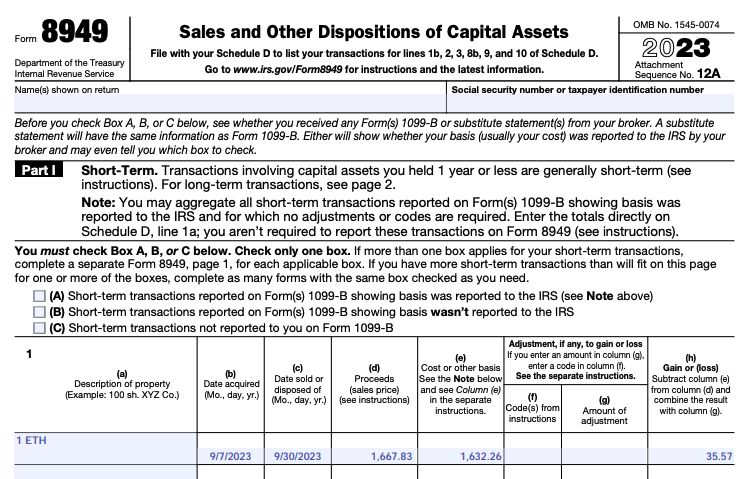
Once you have your meticulously maintained records and calculated your capital losses, the next step is to accurately report them to the IRS using the appropriate tax forms. The primary forms involved in reporting cryptocurrency capital losses are Form 8949 and Schedule D.
Form 8949: Sales and Other Dispositions of Capital Assets
Form 8949 is where you list all your individual cryptocurrency sales, trades, and dispositions. Each disposition, whether a gain or a loss, needs to be reported line by line. The form is divided into sections based on whether the capital asset was held for a short-term period (one year or less) or a long-term period (more than one year), and whether the transaction was reported to the IRS on Form 1099-B.
For most cryptocurrency transactions, especially those not facilitated by traditional brokers, you'll typically report them in Part I (for short-term transactions) or Part II (for long-term transactions) in "Box C" – meaning the basis was not reported to the IRS. This is common because most crypto exchanges do not issue Form 1099-B with cost basis information to the IRS.
For each disposition, you will need to provide:
- Description of Property: E.g., "1.5 BTC" or "100 ETH".
- Date Acquired: The exact date you purchased or received the crypto.
- Date Sold or Disposed Of: The exact date you sold or disposed of the crypto.
- Proceeds: The amount of money or FMV of other property you received from the sale.
- Cost or Other Basis: Your original cost plus any adjustments (e.g., fees).
- Adjustment Code(s) and Amount: Generally not applicable for straightforward crypto sales, but important to be aware of.
- Gain or (Loss): The calculated gain or loss for that specific transaction.
It's crucial to correctly classify your losses as either short-term capital loss or long-term capital loss. Short-term losses are netted against short-term gains, and long-term losses against long-term gains. This distinction impacts how your losses are applied and their overall tax implications.
Schedule D: Capital Gains and Losses
After you've meticulously listed all your cryptocurrency dispositions on Form 8949, the totals from this form are then transferred to Schedule D. Schedule D is where your net capital gains or losses are summarized and calculated. It combines all your capital gains and losses, not just from crypto, but also from stocks, bonds, and other investments.
On Schedule D, your net short-term capital gains/losses from Form 8949 are combined, and your net long-term capital gains/losses are combined. Ultimately, these are netted against each other to arrive at your overall net capital gain or loss for the year. This final figure is what gets reported on your Form 1040.
A significant benefit of reporting losses is the capital loss deduction. If your capital losses exceed your capital gains for the year, you can deduct up to $3,000 of that net capital loss against your ordinary income (such as wages). Any remaining net capital loss that exceeds the $3,000 limit can be carried forward indefinitely to offset capital gains and up to $3,000 of ordinary income in future tax years. This is known as a capital loss carryover, a powerful tool for reducing future tax liabilities.
Strategic Considerations for Maximizing Crypto Loss Deductions
Beyond simply reporting your losses, there are strategic approaches you can take to maximize the tax benefits. Understanding these can significantly impact your overall tax burden.
Tax-Loss Harvesting with Cryptocurrency
Tax-loss harvesting is a strategy where you intentionally sell investments at a loss to offset capital gains and potentially a portion of your ordinary income. For cryptocurrency, this involves selling underperforming assets to realize a loss, which can then be used to reduce your taxable capital gains from other profitable crypto sales or even traditional investments. If you have more losses than gains, you can deduct up to $3,000 against ordinary income, carrying forward the rest.
The key challenge with crypto and tax-loss harvesting is the wash sale rule. The wash sale rule prevents taxpayers from claiming a loss on the sale of a security if they acquire a substantially identical security within 30 days before or after the sale. Crucially, the IRS has stated that the wash sale rule, as defined by Section 1091 of the Internal Revenue Code, currently applies only to "stocks or securities." Since the IRS treats cryptocurrency as property, not a stock or security, the wash sale rule does not currently apply to cryptocurrency. This means you could theoretically sell your Bitcoin at a loss and immediately buy it back, realizing the loss for tax purposes. However, it's important to note that tax laws can change, and some tax professionals advise caution or predict that the IRS might eventually extend the wash sale rule to crypto. Always stay updated on the latest IRS guidance.
Theft and Scams: A Nuanced Approach
As mentioned, the rules for theft losses changed significantly after the Tax Cuts and Jobs Act of 2017. For individuals, personal casualty and theft losses are generally no longer deductible unless they occur in a federally declared disaster area. However, if your cryptocurrency was held as an investment, a theft or scam could potentially be treated as a capital loss. This requires meticulous documentation, including police reports, transaction records, and any attempts to recover the assets. This is a highly complex area, and it's imperative to consult with a tax professional specializing in crypto to determine the correct classification and deductibility.
Cost Basis Methods and Their Impact
The method you use to determine your cost basis can significantly impact the amount of your reported gains or losses. The most common methods are:
- First-In, First-Out (FIFO): Assumes the first crypto you bought is the first you sell. This is the default method if you don't specify otherwise. It often results in higher capital gains if prices have generally increased over time.
- Last-In, First-Out (LIFO): Assumes the last crypto you bought is the first you sell. Can be advantageous for realizing losses if recent purchases were at higher prices.
- Specific Identification: Allows you to choose which specific units of crypto you are selling. This is often the most tax-efficient method, as it allows you to sell units with the highest cost basis (to minimize gains) or the lowest cost basis (to maximize losses) depending on your tax strategy. Most crypto tax software supports this method.
Choosing the right cost basis method can be a powerful tool for managing your tax liability, especially when you have opportunities for tax-loss harvesting.
Common Pitfalls and Expert Advice for Crypto Loss Reporting
Reporting cryptocurrency losses can be intricate, and many taxpayers fall into common traps. Being aware of these can help you avoid errors and potential issues with the IRS.
Pitfall 1: Inadequate Record-Keeping
This is by far the biggest mistake. Relying solely on exchange summaries is often insufficient, as they rarely provide comprehensive cost basis information across all your platforms. Every single transaction matters, from small buys to complex DeFi interactions. The IRS expects you to have a detailed audit trail.
Pitfall 2: Miscalculating Cost Basis
Incorrectly calculating your cost basis can lead to underreporting or overreporting losses. Remember to include all acquisition fees and accurately convert foreign currency costs to USD at the time of transaction. Different acquisition methods (e.g., mining, staking rewards, gifts, airdrops) have different cost basis rules.
Pitfall 3: Ignoring Small Transactions
Many crypto enthusiasts engage in frequent, small trades. Each one is a taxable event. Ignoring these "micro-transactions" can lead to a significant understatement of your tax liability or an inability to claim all eligible losses.
Pitfall 4: Misunderstanding Short-Term vs. Long-Term Losses
The distinction between short-term capital loss and long-term capital loss is crucial. Assets held for one year or less result in short-term losses, while those held for more than a year result in long-term losses. This affects how they are netted against gains and the overall tax implications.
Pitfall 5: Not Understanding the Wash Sale Rule Nuance
While the wash sale rule does not currently apply to crypto, relying on this without understanding the potential for future changes or specific circumstances (e.g., if you're also trading securities) can be risky. Always consult the latest IRS guidance.
Expert Advice: When to Seek Professional Help
While this guide provides comprehensive information, cryptocurrency tax law is constantly evolving and can be highly complex. If you have significant trading activity, engaged in complex DeFi protocols, or suffered substantial losses from theft, it is highly advisable to consult with a qualified tax professional specializing in cryptocurrency. They can provide personalized advice, help you navigate ambiguities, and ensure full compliance. Additionally, leveraging reputable crypto tax software can automate much of the data aggregation and calculation, significantly reducing manual effort and potential errors. Consider exploring solutions like CoinTracker or Koinly to simplify your tax reporting.
Frequently Asked Questions About Reporting Crypto Losses
Can I deduct cryptocurrency losses against my ordinary income?
Yes, you can. If your net capital losses (after offsetting all capital gains) exceed your capital gains for the year, you are allowed to deduct up to $3,000 of that net capital loss against your ordinary income (such as wages, salaries, or business income). Any remaining net capital loss beyond the $3,000 limit can be carried forward to offset capital gains and up to $3,000 of ordinary income in future tax years. This is a crucial aspect of the capital loss deduction.
Does the wash sale rule apply to cryptocurrency in the U.S.?
Currently, no, the wash sale rule does not apply to cryptocurrency in the U.S. The IRS treats cryptocurrency as property, not as a "stock or security," which are the specific assets covered by the wash sale rule (Internal Revenue Code Section 1091). This means you can sell your crypto at a loss and immediately repurchase it to realize the loss for tax purposes, without violating the rule. However, it's vital to stay informed as tax laws can change, and some tax professionals advise caution given the evolving landscape of IRS guidance on digital assets.
What if my cryptocurrency was stolen or lost in a scam? Can I claim a loss?
For individuals, personal casualty and theft losses are generally no longer deductible after the Tax Cuts and Jobs Act of 2017, unless they occur in a federally declared disaster area. However, if your cryptocurrency was held primarily for investment purposes, a theft or scam might be treated as a capital loss. This is a complex area requiring robust documentation (e.g., police reports, transaction IDs, proof of attempts to recover funds). It's highly recommended to consult a tax professional experienced in cryptocurrency taxation for specific guidance on how to report such an event.
How far back can I report cryptocurrency losses?
You report cryptocurrency losses in the tax year they are realized (i.e., when you sell, trade, or otherwise dispose of the asset). If you have a net capital loss that exceeds the $3,000 deduction limit for a given year, you can carry that excess loss forward indefinitely to offset capital gains and up to $3,000 of ordinary income in future tax years. There isn't a specific time limit on how far back you can carry over losses once they are properly reported in the year they occurred.
Is using crypto tax software mandatory for reporting losses?
No, using crypto tax software is not mandatory, but it is highly recommended, especially if you have numerous transactions. Manually tracking every single transaction, calculating cost basis, and preparing tax forms like Form 8949 can be incredibly time-consuming and prone to errors. Crypto tax software automates this process by integrating with exchanges and wallets, importing transaction history, and generating the necessary reports and forms, making it much easier to accurately report your virtual currency gains and losses.

0 Komentar