
Complete Guide
The advent of 5G technology marks a transformative era for telecommunications, promising unprecedented speeds, ultra-low latency, and massive connectivity. However, realizing the full potential of this complex ecosystem hinges critically on robust and intelligent 5G Key Performance Indicators (KPI) monitoring. As networks evolve from static infrastructure to dynamic, software-defined environments, simply reacting to issues is no longer sufficient. Operators must embrace proactive, data-driven strategies to ensure optimal network performance, meet stringent Service Level Agreements (SLAs), and deliver superior customer experience. This comprehensive guide delves into the intricate world of 5G KPI monitoring, exploring its significance, the critical metrics, advanced methodologies, and best practices for achieving network excellence in the 5G age.
The Imperative of 5G KPI Monitoring
Unlike previous generations, 5G is not just about faster mobile broadband; it's a foundational technology enabling diverse use cases from enhanced mobile broadband (eMBB) to ultra-reliable low-latency communication (URLLC) and massive machine-type communication (mMTC). Each of these demands a unique set of performance parameters and stringent reliability. Without precise and continuous 5G KPI monitoring, operators risk service degradation, revenue loss, and diminished trust. Effective monitoring acts as the nervous system of the 5G network, providing real-time insights into its health and efficiency.
Evolving Network Demands and Complexity
The 5G architecture introduces significant complexity, incorporating technologies like network slicing, edge computing, virtualization (NFV, SDN), and multi-access edge computing (MEC). These innovations, while powerful, create a distributed and dynamic environment where traditional monitoring tools often fall short. A single service might traverse multiple network slices, virtual functions, and physical infrastructures, making root cause analysis incredibly challenging without a holistic view. Comprehensive 5G network performance monitoring is essential to navigate this intricacy and ensure seamless operation across all layers.
Proactive Problem Resolution and Service Assurance
In the 5G era, downtime or performance bottlenecks are not just inconvenient; they can have severe consequences for mission-critical applications like autonomous vehicles, remote surgery, or smart grids. Proactive 5G KPI monitoring enables operators to identify potential issues before they impact services, shifting from reactive troubleshooting to predictive maintenance. This capability is vital for maintaining high network reliability and delivering on the promise of 5G's transformative applications. It's about ensuring end-to-end service assurance, from the radio access network (RAN) to the core and beyond.
Key Performance Indicators (KPIs) in 5G Networks
KPIs are quantifiable metrics used to track and assess the performance of specific aspects of the 5G network. They serve as vital indicators of network health, service quality, and operational efficiency. The nature of 5G necessitates a broader and more granular set of KPIs compared to 4G, covering not just radio performance but also network slicing, virtualization, and edge computing.
Defining 5G KPIs: A Paradigm Shift
The definition of 5G KPIs moves beyond traditional metrics like signal strength or call drops. It encompasses metrics directly tied to the new 5G use cases and architectural elements. For instance, latency becomes a critical KPI for URLLC, while connection density is paramount for mMTC. Operators must tailor their 5G KPI monitoring strategies to align with the specific requirements of each service and slice.
Categories of 5G KPIs
- Throughput and Capacity:
- Peak Data Rate: Maximum data transfer speed (e.g., Gbps).
- Average User Throughput: Actual speed experienced by users.
- Cell/Slice Throughput: Data volume handled by a specific cell or network slice.
- Resource Utilization: Percentage of network resources (spectrum, processing power) being used.
- Latency and Responsiveness:
- End-to-End Latency: Time taken for data to travel from source to destination, crucial for URLLC.
- Radio Latency: Time delay within the radio interface.
- Core Network Latency: Delay within the core network.
- Jitter: Variation in packet arrival time, impacting real-time applications.
- Reliability and Availability:
- Service Availability: Uptime of services and network components.
- Packet Loss Rate: Percentage of data packets lost during transmission.
- Handover Success Rate: Percentage of successful transitions between cells or base stations.
- Connection Establishment Success Rate: Rate at which new connections are successfully formed.
- Efficiency and Resource Management:
- Energy Consumption: Power usage per unit of data or service, critical for sustainability.
- Spectral Efficiency: Data rate achievable over a given bandwidth.
- Network Slice Performance: Individual performance metrics for each logical slice, ensuring SLA adherence.
- Virtual Network Function (VNF) Performance: KPIs related to the health and performance of virtualized network elements.
- Mobility Management:
- Mobility Success Rate: Overall success of user equipment (UE) mobility across the network.
- Inter-RAT Handover Success Rate: Handover success between 5G and other radio access technologies (e.g., 4G).
- Security KPIs:
- Authentication Success Rate: Success rate of user authentication processes.
- Anomaly Detection Rate: Frequency of detected security anomalies or breaches.
- Threat Response Time: Time taken to respond to identified security threats.
Methodologies for Effective 5G KPI Monitoring
Effective 5G KPI monitoring requires sophisticated tools and methodologies that can handle the massive data volumes and complexity of modern networks. Legacy systems are often inadequate, necessitating a shift towards intelligent, automated solutions.
Real-time Data Collection and Analytics
The foundation of robust 5G network performance monitoring is the ability to collect vast amounts of data in real-time from various network elements – gNBs, core network functions, edge servers, and user devices. This data includes call detail records (CDRs), session management functions (SMF) logs, network function (NF) metrics, and more. Advanced analytics platforms then process this raw data, transforming it into actionable insights. This processing often involves stream processing for immediate analysis and batch processing for historical trends and deeper dives.
AI and Machine Learning in KPI Monitoring
The sheer volume and velocity of data in 5G networks make manual monitoring impractical. Artificial Intelligence (AI) and Machine Learning (ML) are indispensable for intelligent 5G KPI monitoring.
- Anomaly Detection: ML algorithms can learn normal network behavior patterns and automatically flag deviations that indicate potential issues, often before they impact services. This moves beyond static thresholds to dynamic baselining.
- Predictive Analytics: By analyzing historical data and current trends, AI can predict future network congestion, equipment failures, or service degradation, enabling proactive interventions. This is crucial for optimizing resource utilization and preventing outages.
- Root Cause Analysis: AI-driven tools can correlate events across different network layers and domains, rapidly identifying the underlying cause of performance issues, significantly reducing mean time to repair (MTTR).
- Automated Remediation: In some cases, AI can even trigger automated actions to resolve identified issues, such as rerouting traffic or scaling up resources, enhancing operational efficiency.
Centralized Dashboards and Visualization
To provide a unified view of network health, data from various sources and AI/ML insights must be presented through intuitive, centralized dashboards. These dashboards should be customizable, allowing different stakeholders (network engineers, operations teams, business managers) to focus on the KPIs most relevant to their roles. Effective visualization, using charts, graphs, and heatmaps, makes complex data understandable at a glance, facilitating quicker decision-making for 5G network optimization.
Proactive Alarming and Anomaly Detection
Beyond simply displaying data, a sophisticated 5G KPI monitoring system must incorporate intelligent alarming. This means setting dynamic thresholds based on historical performance and predicted trends, rather than static limits. When an anomaly is detected or a KPI deviates significantly, automated alerts should be triggered, notifying relevant personnel through various channels (email, SMS, ticketing systems). This ensures rapid response and minimizes the impact of potential issues on customer experience.
Challenges in 5G KPI Monitoring
Despite the advanced tools available, monitoring 5G networks presents unique challenges that operators must address.
Data Volume and Velocity
The sheer scale of data generated by 5G networks – from billions of IoT devices to high-bandwidth video streams – creates a significant challenge for collection, storage, and processing. Traditional data warehouses may struggle to cope, necessitating scalable, cloud-native data platforms and real-time processing capabilities for effective 5G network monitoring.
Network Slicing Complexity
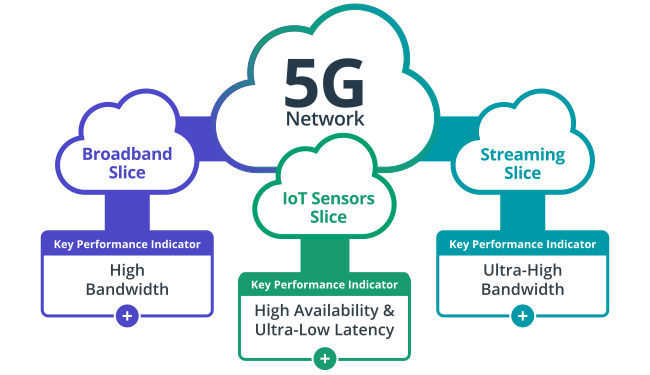
Network slicing allows operators to create multiple virtual networks on a single physical infrastructure, each tailored for specific services with distinct SLAs. Monitoring KPIs for each individual slice, ensuring isolation and performance guarantees, adds a layer of complexity. It requires a monitoring solution that understands the logical separation and can track slice-specific metrics without interference.
Multi-vendor Environments
5G networks often comprise equipment and software from multiple vendors. Integrating data from disparate systems and ensuring interoperability for comprehensive 5G KPI monitoring can be a significant hurdle. Open APIs and standardized data formats are crucial for seamless data exchange and unified visibility.
Security and Privacy Concerns
With more data being collected and processed, ensuring the security and privacy of this sensitive network information is paramount. Monitoring solutions must comply with stringent data protection regulations and incorporate robust cybersecurity measures to prevent unauthorized access or data breaches.
Best Practices for Robust 5G KPI Monitoring
To overcome these challenges and maximize the benefits of 5G KPI monitoring, operators should adopt a strategic approach centered on these best practices:
1. Establishing Clear Baselines and Thresholds
Before effective monitoring can begin, it's essential to establish clear performance baselines for all critical KPIs under normal operating conditions. These baselines should be dynamic, adjusting for time of day, day of week, and seasonal variations. Thresholds should then be set based on these baselines, allowing for intelligent alerting when performance deviates significantly. This moves beyond static, one-size-fits-all limits.
2. Granular Data Collection and Correlation
Collect data at the most granular level possible (e.g., per user, per session, per slice, per network function) to enable detailed analysis and accurate root cause analysis. Crucially, correlate data across different network domains (RAN, core, transport, cloud) and layers to gain an end-to-end view of service performance. This is vital for understanding how issues in one part of the network impact others and for providing comprehensive network assurance.
3. Implementing AI/ML-Powered Analytics
Leverage advanced AI and ML capabilities for anomaly detection, predictive analytics, and automated troubleshooting. This not only enhances the accuracy and speed of issue identification but also reduces the operational burden on human teams, allowing them to focus on more strategic tasks. AI can help in network performance optimization by identifying patterns that lead to sub-optimal performance.
4. Adopting a Unified Monitoring Platform
Invest in a single, unified 5G network monitoring platform that can ingest, process, and visualize data from all network elements, regardless of vendor. This eliminates data silos, provides a holistic view of network health, and simplifies management. The platform should support open standards and APIs for future extensibility.
5. Prioritizing Customer Experience (CX) KPIs
While technical KPIs are crucial, always link them back to their impact on customer experience monitoring. Ultimately, the goal of 5G KPI monitoring is to ensure a high-quality experience for end-users. Monitor KPIs like service accessibility, retainability, and integrity from the customer's perspective to ensure true service excellence.
6. Continuous Optimization and Feedback Loops
Network conditions and service demands are constantly evolving. Implement a continuous optimization cycle where monitoring insights feed back into network planning, design, and operations. Regularly review and refine KPI definitions, thresholds, and monitoring strategies based on performance trends and new service requirements.
7. Training and Skill Development
Ensure that network operations teams are adequately trained in the use of new 5G KPI monitoring tools and understand the nuances of 5G network architecture. Developing skills in data analytics, AI/ML interpretation, and cloud-native environments is essential for maximizing the value of advanced monitoring solutions.
The Future of 5G KPI Monitoring
The trajectory of 5G KPI monitoring points towards even greater automation and intelligence. The integration of closed-loop automation, where AI-driven insights directly trigger network adjustments without human intervention, will become more prevalent. Edge computing will enable localized, real-time monitoring and analytics, reducing backhaul traffic and enabling faster responses for latency-sensitive applications. Furthermore, as networks become more disaggregated and open, the importance of open-source monitoring solutions and community-driven innovation will grow, fostering a more collaborative approach to network assurance and operational efficiency in the 5G ecosystem.
Frequently Asked Questions
What is the primary goal of 5G KPI monitoring?
The primary goal of 5G KPI monitoring is to ensure the optimal performance, reliability, and efficiency of 5G networks and the services they deliver. This involves continuously tracking key metrics to identify potential issues proactively, ensure compliance with Service Level Agreements (SLAs), optimize resource utilization, and ultimately deliver a superior customer experience across diverse 5G use cases like eMBB, URLLC, and mMTC.
How do 5G KPIs differ from 4G KPIs?
While some core concepts remain, 5G KPIs are significantly more diverse and granular than 4G KPIs. 5G introduces new architectural elements like network slicing, edge computing, and virtualization, demanding specific KPIs for each. For example, 5G emphasizes ultra-low latency, massive connection density, and energy efficiency, leading to a focus on metrics like end-to-end latency for URLLC, connection establishment rates for mMTC, and energy consumption per bit, which were less critical or non-existent in 4G. 5G also places a stronger emphasis on network slicing management and the performance of virtual network functions (VNFs).
What role does AI play in 5G KPI monitoring?
AI and Machine Learning are transformative in 5G KPI monitoring due to the immense volume and complexity of data. AI enables predictive analytics, allowing operators to anticipate network issues before they occur. It powers advanced anomaly detection, identifying unusual network behavior that static thresholds might miss. Furthermore, AI facilitates automated root cause analysis by correlating events across disparate network layers and components, significantly reducing the time required to diagnose and resolve problems. This intelligence is crucial for achieving high levels of operational efficiency and network automation in 5G.
Can 5G KPI monitoring help with network slicing management?
Absolutely. 5G KPI monitoring is indispensable for effective network slicing management. Each network slice is designed to meet specific performance requirements (e.g., dedicated bandwidth, guaranteed low latency). Robust monitoring allows operators to track KPIs granularly for each individual slice, ensuring that it consistently meets its defined SLAs. This includes monitoring slice-specific throughput, latency, packet loss, and resource utilization, providing critical insights into the health and performance of isolated virtual networks operating on shared infrastructure.
What are some actionable tips for improving 5G network performance through KPI monitoring?
- Implement End-to-End Visibility: Don't just monitor individual network segments. Use tools that provide a holistic view from the user device to the core network and beyond, correlating data across all layers and domains for true service assurance.
- Focus on User-Centric KPIs: While technical KPIs are important, prioritize metrics that directly impact the end-user experience, such as application performance, video streaming quality, and voice call quality, to truly understand service delivery.
- Automate Thresholds with ML: Move away from static thresholds. Utilize machine learning to dynamically adjust KPI thresholds based on historical patterns, time of day, and network load, reducing false positives and improving the accuracy of alerts.
- Integrate with Orchestration Systems: For proactive network optimization, integrate your 5G KPI monitoring platform with network orchestration and automation systems. This allows for closed-loop automation, where performance deviations can automatically trigger remedial actions like resource scaling or traffic rerouting.
- Conduct Regular Performance Reviews: Beyond real-time monitoring, schedule regular, in-depth reviews of historical KPI data to identify long-term trends, capacity needs, and areas for strategic network upgrades or reconfigurations, contributing to continuous network performance optimization.

0 Komentar