
Complete Guide
In today's digital landscape, delivering a truly personalized experience is no longer a luxury—it's a fundamental expectation. From e-commerce giants to streaming services and news platforms, the ability to suggest relevant products, content, or services directly impacts user engagement, retention, and revenue. This is where recommendation systems, powered by cutting-edge machine learning algorithms, become indispensable. As a professional SEO expert and content strategist, I understand the critical role these systems play in enhancing user experience and driving business growth. This comprehensive guide will delve deep into how to use machine learning for building a recommendation system, offering practical insights and advanced techniques to help you create intelligent, highly effective personalization engines.
Understanding the Core of Recommendation Systems
At its heart, a recommendation system aims to predict a user's preference for an item, suggesting items they are most likely to enjoy or find useful. The magic truly happens when we infuse these systems with machine learning capabilities, allowing them to learn from vast amounts of data and adapt over time. The goal is to move beyond simple popularity lists and provide truly tailored suggestions that resonate with individual users.
Types of Recommendation Systems: The Foundation
Before diving into the ML pipeline, it's crucial to grasp the fundamental types of recommendation approaches:
- Collaborative Filtering: This widely adopted technique makes recommendations based on the preferences and behaviors of similar users or items.
- User-Based Collaborative Filtering: "Users who are similar to you liked X, Y, and Z." It identifies users with similar tastes and recommends items they have enjoyed.
- Item-Based Collaborative Filtering: "If you liked item A, you might also like item B, because users who liked A also liked B." It identifies relationships between items.
A key strength of collaborative filtering is its ability to recommend diverse items, but it often struggles with the cold start problem for new users or items.
- Content-Based Filtering: This method recommends items similar to those a user has liked in the past. It relies on the attributes or characteristics of the items and the user's profile.
- For example, if a user enjoys action movies with specific actors, a content-based system would recommend other action movies featuring those actors or similar plot lines.
Content-based systems are excellent for addressing the cold start problem for new users (if their initial preferences are known) and can provide transparent explanations for recommendations. However, they may suffer from over-specialization, limiting the discovery of new, diverse items.
- Hybrid Recommendation Systems: The most robust and widely used approach in real-world applications, hybrid systems combine elements of both collaborative and content-based filtering to mitigate their individual weaknesses. This synergy often leads to superior recommendation quality and addresses challenges like data sparsity more effectively.
The Machine Learning Pipeline for Building a Recommendation System
Building an effective recommendation system with machine learning is an iterative process involving several critical stages. Each stage requires careful consideration and optimization to ensure the system delivers accurate and relevant suggestions.
Phase 1: Data Collection and Preparation – The Fuel for ML
The quality and quantity of your data are paramount. Machine learning models are only as good as the data they're trained on.
- Data Sources:
- Explicit Feedback: User ratings (1-5 stars), likes/dislikes, direct preferences. This is ideal but often scarce.
- Implicit Feedback: User interactions like clicks, views, purchases, watch time, search queries, browsing history. This is abundant and highly valuable for understanding user behavior analysis.
- Item Metadata: Attributes of items (e.g., genre, director, actors for movies; brand, category, features for products).
- User Profile Data: Demographics, past purchases, stated interests.
- Data Preprocessing and Feature Engineering:
- Cleaning: Handling missing values, removing duplicates, standardizing formats.
- Normalization/Scaling: Ensuring features are on a comparable scale for algorithms.
- Feature Engineering: This is a critical step where raw data is transformed into features that better represent the underlying patterns. Examples include:
- Creating user-item interaction matrices (e.g., a sparse matrix where rows are users, columns are items, and values are ratings or interaction counts).
- Generating time-based features (e.g., recency of interaction).
- Deriving latent features using techniques like matrix factorization (e.g., Singular Value Decomposition - SVD, Alternating Least Squares - ALS).
- Encoding categorical features (one-hot encoding, embedding layers for deep learning models).
- Addressing Data Sparsity: Most user-item interaction matrices are extremely sparse (users interact with only a tiny fraction of available items). Techniques like matrix factorization, item similarity, or incorporating content features help mitigate this challenge.
Phase 2: Model Selection and Training – The Brain of the System
Choosing the right machine learning model depends on your data characteristics, computational resources, and desired system complexity.
- Traditional Machine Learning Models:
- Matrix Factorization (e.g., SVD, FunkSVD, ALS): Decomposes the large user-item interaction matrix into two lower-dimensional matrices representing user and item latent factors. This is highly effective for collaborative filtering.
- K-Nearest Neighbors (KNN): Finds similar users or items based on distance metrics and recommends accordingly.
- Decision Trees/Random Forests: Can be used for content-based recommendations by predicting user preference based on item features.
- Deep Learning Models: With the rise of deep learning, more sophisticated personalization algorithms are emerging.
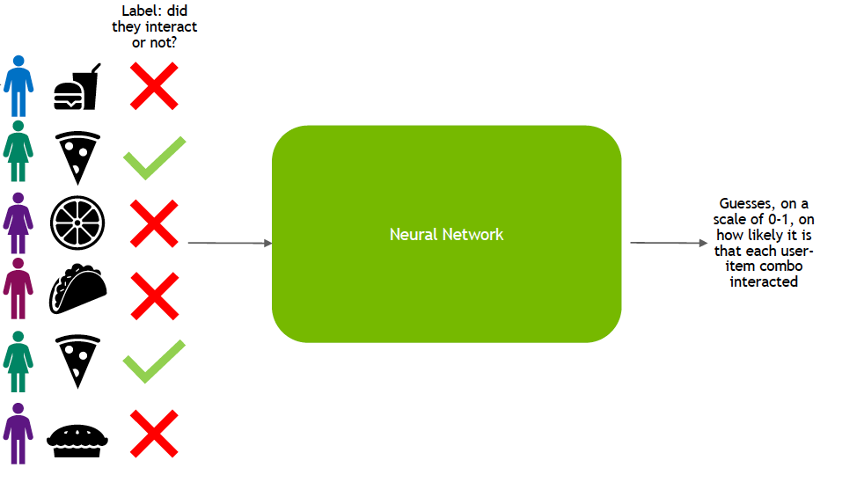
- Neural Networks (e.g., Multi-Layer Perceptrons - MLPs): Can learn complex non-linear relationships between users, items, and their interactions.
- Autoencoders: Used for dimensionality reduction and learning latent representations, particularly effective for implicit feedback data.
- Recurrent Neural Networks (RNNs) / Transformers: Ideal for sequential recommendation tasks, where the order of interactions matters (e.g., predicting the next item in a user's browsing session or playlist).
- Graph Neural Networks (GNNs): Excellent for modeling relationships in complex networks, such as social networks or knowledge graphs, enhancing recommendations.
- Training and Optimization:
- Loss Functions: Defining what the model should minimize (e.g., Mean Squared Error for explicit ratings, Binary Cross-Entropy for implicit feedback).
- Regularization: Techniques like L1/L2 regularization to prevent overfitting.
- Hyperparameter Tuning: Optimizing model parameters (learning rate, number of layers, embedding dimensions) using techniques like grid search or Bayesian optimization.
Phase 3: Addressing Key Challenges – Building Robustness
Even with the best data and models, specific challenges are inherent to recommendation systems.
- The Cold Start Problem: How to recommend to new users with no history or new items with no interactions?
- For New Users: Recommend popular items, ask for initial preferences, use demographic data (if available), or leverage content-based methods.
- For New Items: Recommend based on item features (content-based), or recommend to users who have interacted with similar items.
- Hybrid approaches are often the best solution here, combining initial content-based suggestions with collaborative filtering as more data accumulates.
- Scalability: As user and item bases grow, the computational demands for training and serving recommendations can be immense.
- Distributed computing frameworks (e.g., Spark).
- Approximation algorithms (e.g., Locality Sensitive Hashing - LSH).
- Efficient data structures and indexing.
- Serendipity vs. Relevance: Striking a balance between recommending highly relevant items (that users expect) and introducing novel, unexpected items (serendipity) that they might also love. Overly relevant systems can lead to a "filter bubble."
- Explainability and Trust: Users are more likely to trust and act on recommendations if they understand why an item was suggested. Building transparent models or adding explanation features is crucial.
Phase 4: Evaluation and Deployment – Measuring Success and Going Live
The final steps involve rigorously testing your system and putting it into production.
- Evaluation Metrics:
- Offline Evaluation: Using historical data to assess model performance.
- Accuracy Metrics: RMSE (Root Mean Squared Error), MAE (Mean Absolute Error) for explicit ratings.
- Ranking Metrics: Precision@K, Recall@K, F1-score@K, NDCG (Normalized Discounted Cumulative Gain) for implicit feedback and ranking quality.
- Online Evaluation (A/B Testing): The ultimate test. Deploying different recommendation strategies to a small subset of live users and measuring their real-world impact on key business metrics (e.g., click-through rate, conversion rate, engagement, time spent). This provides concrete evidence of your system's effectiveness.
- Offline Evaluation: Using historical data to assess model performance.
- Model Deployment and MLOps:
- Integration: Seamlessly integrating the recommendation engine into your application or website.
- Real-time Recommendations: For dynamic platforms, the ability to generate recommendations in real-time based on a user's current session is critical. This often involves low-latency serving infrastructure.
- Monitoring: Continuously monitoring model performance, data drift, and system health in production.
- Retraining: Establishing a pipeline for regular model retraining with fresh data to ensure recommendations remain relevant and accurate over time. This is a core aspect of MLOps best practices.
Actionable Tips for Building Robust Recommendation Systems
As an SEO expert, I emphasize that user experience is paramount. A well-built recommendation system significantly enhances this experience. Here are some actionable tips:
- Start Simple, Iterate and Scale: Don't aim for the most complex deep learning model from day one. Begin with a simpler collaborative filtering or content-based approach, gather data, prove its value, and then gradually introduce more sophisticated models like deep learning models as your understanding and data grow.
- Focus on User Experience (UX): Recommendations should feel natural, not intrusive. Consider placement, quantity, and presentation. Allow users to provide feedback on recommendations (e.g., "Not interested," "Why was this recommended?").
- Embrace Hybrid Approaches: Combining collaborative and content-based methods almost always yields better results, especially in handling the cold start problem and improving overall recommendation quality.
- Leverage Implicit Feedback: While explicit ratings are great, implicit signals (clicks, views, purchases) are far more abundant and often reflect true preferences more accurately. Master the art of extracting meaningful signals from user interactions.
- Don't Forget Business Goals: Align your recommendation system's objectives with your business goals. Are you trying to increase sales, improve engagement, or diversify consumption? Your evaluation metrics should reflect these goals.
- Implement A/B Testing Religiously: Offline metrics are useful for development, but A/B testing is the only way to confirm if your recommendations truly drive desired business outcomes.
- Consider Ethical AI: Be mindful of potential biases in your data that could lead to unfair or discriminatory recommendations. Ensure transparency and fairness are built into your system design.
- Continuous Monitoring and Retraining: User preferences evolve, and new items are constantly added. Your models need to be regularly updated and retrained to remain effective.
Implementing machine learning for building a recommendation system is a strategic investment that pays dividends in enhanced user satisfaction, increased engagement, and improved business metrics. By following these guidelines and continuously optimizing your system, you can unlock the full potential of personalization for your platform. If you're ready to transform your user experience with intelligent recommendations, consider consulting with experts in data science and machine learning to guide your journey.
Frequently Asked Questions
What is the primary benefit of using machine learning in recommendation systems?
The primary benefit of using machine learning in recommendation systems is its ability to learn complex patterns and relationships from vast datasets, enabling highly personalized and accurate suggestions. Unlike static, rule-based systems, machine learning algorithms can adapt to evolving user behavior analysis, discover non-obvious connections between items and users, and continuously improve their performance over time. This leads to increased user engagement, higher conversion rates, and a significantly improved overall user experience by providing truly relevant content or product suggestions.
How do recommendation systems handle the "cold start problem" for new users or items?
The cold start problem is a significant challenge where the system lacks sufficient data for new users or items to make accurate recommendations. Machine learning systems address this through several strategies: for new users, they might initially recommend popular items, ask for explicit preferences, or use demographic data. For new items, recommendations can be based on their content attributes (e.g., genre, keywords) using content-based filtering, or by leveraging initial interactions from a small group of users. Often, hybrid recommendation systems are employed, which combine content-based methods for cold start scenarios with collaborative filtering as more interaction data becomes available, ensuring a smoother initial experience.
What are the key evaluation metrics for assessing a recommendation system's performance?
Evaluating a recommendation system's performance involves both offline and online metrics. For offline evaluation (using historical data), common evaluation metrics include RMSE (Root Mean Squared Error) and MAE (Mean Absolute Error) for explicit rating prediction accuracy. For ranking-based recommendations, metrics like Precision@K, Recall@K, and NDCG (Normalized Discounted Cumulative Gain) are crucial, measuring the relevance of the top-K recommendations. Online evaluation is performed through A/B testing, where real-world user engagement (e.g., click-through rates, conversion rates, time spent) is measured against different recommendation strategies to determine their actual business impact.

0 Komentar