
Quantum Computing Advantages and Disadvantages: Unlocking the Future of Computation
Embark on a journey into the fascinating realm of quantum computing, a revolutionary technology poised to redefine the boundaries of computational power. This comprehensive guide delves deep into the inherent quantum computing advantages and disadvantages, providing a balanced perspective on its immense potential and the formidable hurdles it faces. Understanding these nuances is crucial for anyone looking to grasp the true impact of this transformative field on industries ranging from healthcare to finance, and to prepare for the quantum era.
The Transformative Advantages of Quantum Computing
At its core, quantum computing leverages the perplexing principles of quantum mechanics – namely superposition and entanglement – to process information in ways utterly impossible for even the most powerful classical computers. This fundamental difference bestows upon quantum machines a set of unique advantages that promise to solve problems currently considered intractable.
Unprecedented Computational Power for Complex Problems
The ability of qubits (quantum bits) to exist in multiple states simultaneously, and to be entangled with one another, allows quantum computers to explore vast numbers of possibilities concurrently. This parallel processing capability leads to an exponential increase in computational power, making them ideal for specific, highly complex tasks:
- Drug Discovery and Materials Science: Simulating molecular interactions with exquisite precision is a task that overwhelms classical systems. Quantum computers can model complex chemical reactions and material properties at the atomic level, accelerating the discovery of new drugs, catalysts, and advanced materials. This could revolutionize areas like medicine, energy storage, and manufacturing.
- Financial Modeling and Optimization: The financial sector deals with intricate models involving countless variables, from portfolio optimization to risk assessment and fraud detection. Quantum algorithms can analyze market fluctuations, perform Monte Carlo simulations, and optimize trading strategies with unparalleled speed and accuracy, leading to more robust financial decisions.
- Artificial Intelligence and Machine Learning: Quantum machine learning (QML) holds the promise of accelerating training times for complex AI models, enhancing pattern recognition, and improving optimization for deep learning algorithms. This could lead to breakthroughs in areas like natural language processing, computer vision, and personalized medicine, pushing the boundaries of what AI can achieve.
- Cryptography and Cybersecurity: While a double-edged sword, one of the most significant advantages is the potential for quantum computers to break currently unbreakable encryption standards (e.g., RSA and ECC) using algorithms like Shor's algorithm. Conversely, they also offer the promise of developing new, quantum-resistant encryption methods, ensuring future data security. This dual capability makes understanding quantum's impact on cybersecurity paramount.
- Logistics and Supply Chain Optimization: Global supply chains are incredibly complex networks. Quantum computers can optimize routes, manage inventories, and schedule deliveries more efficiently than ever before, potentially saving billions in operational costs and reducing environmental impact. Problems like the "traveling salesman problem" become solvable for much larger datasets.
This immense processing capability is not about simply being faster at every task, but about solving entirely new classes of problems that are computationally infeasible for classical machines, marking a true paradigm shift in what's possible.
Revolutionizing Data Processing and Analysis
Beyond raw computational speed, quantum technology offers novel approaches to handling and interpreting vast datasets. For instance, quantum search algorithms like Grover's algorithm can search unsorted databases significantly faster than their classical counterparts. This has profound implications for industries reliant on efficient data retrieval and analysis, from bioinformatics to large-scale data mining.
The ability to process and analyze data in new ways could unlock insights currently hidden within massive datasets, paving the way for advanced scientific discoveries and more informed decision-making across all sectors. Organizations dealing with big data, such as those in climate modeling or personalized healthcare, stand to gain immensely from these advancements. For more insights, consider exploring our guide on quantum algorithms.
Navigating the Challenges: Disadvantages of Quantum Computing
Despite its awe-inspiring potential, quantum computing is still in its nascent stages, grappling with a multitude of significant technical, economic, and ethical challenges. These disadvantages currently limit its widespread adoption and practical application, highlighting that the path to quantum supremacy is far from smooth.
Technical and Engineering Hurdles
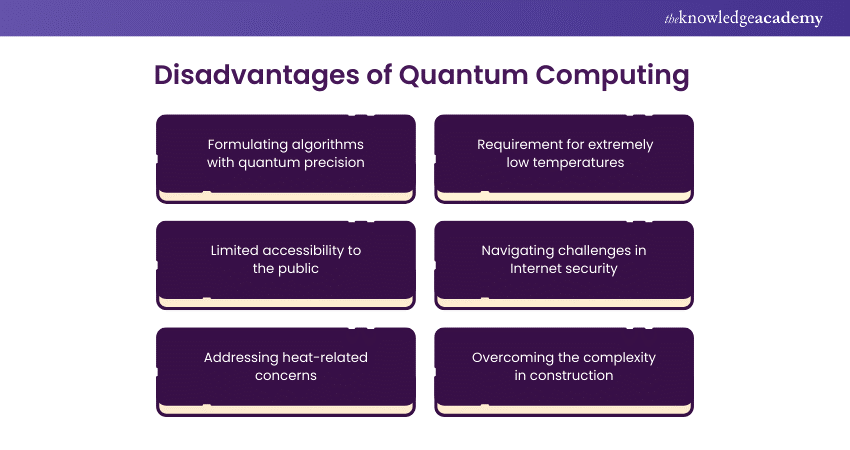
Building and maintaining a functional quantum computer is an incredibly complex undertaking, demanding cutting-edge physics and engineering expertise. The inherent fragility of quantum states poses the most formidable obstacles:
- Decoherence and Error Rates: Qubits are extremely sensitive to their environment. Even tiny disturbances like stray electromagnetic fields or temperature fluctuations can cause them to lose their quantum state (decoherence), leading to errors. Maintaining coherence for long enough to perform complex calculations is one of the biggest challenges, requiring sophisticated error correction techniques that are resource-intensive.
- Scalability Challenges: While researchers have successfully built quantum processors with dozens or even hundreds of qubits, scaling up to the thousands or millions of stable, interconnected qubits required for practical, fault-tolerant quantum computation is a monumental task. Each additional qubit introduces further complexity and potential for error.
- Cryogenic Temperatures and Environmental Control: Many quantum computing architectures, such as superconducting qubits, require extreme cooling, often to temperatures near absolute zero (millikelvin range). This necessitates elaborate and expensive cryogenic systems, making the hardware large, costly, and difficult to maintain outside specialized laboratories. Other approaches, like trapped ions, have different, but equally challenging, environmental control requirements.
- Quantum Hardware Instability: Current quantum hardware is prone to noise and errors. Achieving fault tolerance – where errors can be reliably detected and corrected – demands a significantly higher number of physical qubits to encode a single logical qubit, further exacerbating the scalability problem. This instability means that current quantum computers are often referred to as "Noisy Intermediate-Scale Quantum" (NISQ) devices.
Overcoming these fundamental technical hurdles requires continuous breakthroughs in materials science, quantum physics, and engineering. The journey from noisy, small-scale prototypes to truly robust and scalable quantum machines is a long and arduous one, demanding significant global investment in quantum research and development.
Economic and Accessibility Barriers
Beyond the technical complexities, the economic realities of quantum computing present substantial barriers to entry and widespread adoption:
- Exorbitant Costs: The research, development, and manufacturing of quantum hardware are incredibly expensive. The specialized materials, advanced fabrication techniques, and complex cooling systems contribute to astronomical costs, making quantum computers accessible only to well-funded governments, large corporations, and academic institutions.
- Limited Talent Pool: There is a severe global shortage of professionals with expertise in quantum mechanics, quantum information science, and quantum engineering. Developing the algorithms, building the hardware, and even understanding the results requires a highly specialized skill set that is currently rare, hindering progress and adoption.
- Infrastructure Requirements: Deploying quantum computers requires not just the hardware itself but also significant supporting infrastructure, including dedicated facilities, power supplies, and highly skilled maintenance teams. This makes on-premise deployment impractical for most organizations.
These economic factors mean that while quantum computing promises revolutionary benefits, its immediate impact will likely be concentrated within a few elite organizations capable of bearing the investment. Bridging this gap will require significant efforts in education and collaborative research initiatives.
Ethical and Societal Implications
As with any powerful technology, quantum computing raises important ethical and societal questions that must be addressed proactively:
- Cybersecurity Risks: The ability of quantum computers to break current encryption standards poses an existential threat to global data security. If not adequately prepared, governments, financial institutions, and individuals could face unprecedented levels of cyber espionage and data theft. This necessitates a global transition to post-quantum cryptography.
- Job Displacement: While quantum computing will undoubtedly create new jobs, it also has the potential to automate complex tasks currently performed by humans, leading to job displacement in certain sectors, particularly those involving optimization and data analysis.
- Accessibility Gap and Digital Divide: The high cost and specialized nature of quantum computing could exacerbate the existing digital divide, creating a significant gap between those who can leverage its power and those who cannot, potentially leading to increased societal inequalities.
Addressing these implications requires careful consideration, robust policy frameworks, and international collaboration to ensure that the benefits of quantum computing are distributed equitably and responsibly.
Bridging the Gap: Overcoming Quantum Computing's Limitations
Despite the substantial hurdles, the global scientific and engineering community is making rapid strides in addressing the disadvantages of quantum computing. The journey is long, but solutions are emerging through dedicated research and innovative approaches.
Advancements in Error Correction and Hardware Design
The primary focus for overcoming technical limitations lies in developing more robust qubits and sophisticated error mitigation strategies. Researchers are exploring various qubit technologies, including superconducting qubits, trapped ions, photonic qubits, and topological qubits, each with its own strengths and weaknesses regarding coherence and scalability. Significant progress is being made in:
- Quantum Error Correction Codes: Developing complex algorithms that can detect and correct errors without directly observing the qubits (which would cause decoherence). While still in early stages, these codes are crucial for building fault-tolerant quantum computers.
- Improved Qubit Coherence Times: Engineering better isolation techniques and cleaner materials to allow qubits to maintain their quantum states for longer durations, enabling more complex computations.
- Modular Architectures: Instead of building one massive quantum chip, developing smaller, interconnected quantum modules that can communicate, akin to how classical supercomputers are built from many processors. This could simplify scalability.
- Cryogenic Innovations: Advancements in refrigeration technology are making it more efficient and less costly to maintain the ultra-cold environments required for many quantum hardware types.
These ongoing advancements are incrementally pushing the boundaries of what's possible, moving us closer to the era of practical quantum applications. Stay informed on the latest breakthroughs by subscribing to our newsletter.
Fostering Collaboration and Talent Development
Addressing the economic and talent barriers requires a concerted effort from academia, industry, and government. Initiatives include:
- Open-Source Quantum Platforms: Companies like IBM and Google offer cloud-based access to their quantum processors, allowing researchers and developers to experiment with quantum computing without needing to invest in expensive hardware. This democratizes access and fosters innovation.
- Educational Programs: Universities globally are launching specialized degrees and courses in quantum information science, aiming to build a robust pipeline of quantum-literate professionals.
- International Research Collaborations: Governments and corporations are investing heavily in joint research projects to accelerate discovery and share resources, pooling expertise to tackle the most challenging problems.
These efforts are crucial for expanding the quantum ecosystem and making the technology more accessible and understandable to a broader audience, fostering a new generation of quantum innovators.
The Future Landscape: Quantum's Potential and Practical Advice
While the disadvantages of quantum computing are significant, the advantages offer a glimpse into a future of unprecedented problem-solving capabilities. The consensus among experts is that quantum computers will not replace classical computers but will serve as powerful accelerators for specific, computationally intensive tasks, working in tandem with existing infrastructure.
Practical Steps for Businesses and Researchers
For organizations looking to prepare for the quantum era, here are some actionable tips:
- Educate Your Workforce: Start investing in training programs to familiarize your technical teams with the basics of quantum computing and quantum algorithms. Understanding the fundamentals is the first step towards identifying potential applications within your domain.
- Identify Quantum-Ready Problems: Begin assessing your most computationally challenging problems – those that currently overwhelm classical systems. These are the prime candidates for quantum acceleration in the future. Consider areas like optimization, simulation, and complex data analysis.
- Experiment with Cloud-Based Quantum Platforms: Leverage services offered by major tech companies to gain hands-on experience with quantum programming and understand the current capabilities and limitations of quantum hardware. This low-cost entry point allows for practical exploration.
- Invest in Quantum-Resistant Cybersecurity: Proactively research and plan for the transition to post-quantum cryptography standards. This is a critical step for long-term data security, especially for sensitive information that needs to remain secure for decades.
- Foster Cross-Disciplinary Collaboration: Quantum computing is inherently interdisciplinary. Encourage collaboration between your IT, R&D, and business strategy teams to envision how quantum technology might impact your core operations and competitive landscape.
Embracing a proactive approach will position organizations to capitalize on the eventual maturity of quantum technology, transforming challenges into opportunities for innovation and growth. To learn more about specific industry applications, read our article on quantum computing in finance.
Frequently Asked Questions About Quantum Computing
What is the primary advantage of quantum computing over classical computing?
The primary advantage of quantum computing lies in its ability to solve certain complex problems exponentially faster than classical computers. This is due to quantum phenomena like superposition, which allows qubits to represent multiple states simultaneously, and entanglement, where qubits become interconnected and influence each other's states. This enables quantum computers to explore vast computational spaces in parallel, tackling problems that are intractable for even the most powerful supercomputers, particularly in areas like molecular simulation, optimization, and advanced cryptography.
What are the biggest technical challenges facing quantum computing today?
The biggest technical challenges facing quantum computing include decoherence (qubits losing their quantum state due to environmental interference), high error rates, and the difficulty of scalability (building stable processors with a large number of qubits). Additionally, many quantum hardware platforms require extreme environmental control, such as ultra-low cryogenic temperatures, making them expensive and challenging to maintain outside specialized research facilities. Overcoming these hurdles is crucial for achieving fault-tolerant quantum computation.
How will quantum computing impact cybersecurity?
Quantum computing will have a profound, dual impact on cybersecurity. On one hand, powerful quantum algorithms like Shor's algorithm could potentially break many of the public-key encryption standards (e.g., RSA, ECC) that secure our current digital communications and transactions. This poses a significant threat to data privacy and national security. On the other hand, quantum computing also enables the development of new, quantum-resistant cryptographic methods (post-quantum cryptography) designed to withstand attacks from future quantum computers, ensuring the long-term security of digital information. The transition to these new standards is a critical and ongoing effort.
Is quantum computing accessible to small businesses?
Currently, direct ownership of quantum computing hardware is not practical or accessible for small businesses due to its exorbitant cost, complex maintenance, and specialized talent requirements. However, accessibility is rapidly improving through cloud-based quantum platforms offered by major tech companies (e.g., IBM Quantum, Amazon Braket, Google Cloud Quantum AI). These platforms allow small businesses and researchers to access and experiment with quantum processors on a pay-per-use model, democratizing the technology and fostering innovation without the massive upfront investment.
When can we expect widespread quantum computing applications?
Widespread practical applications of fault-tolerant quantum computing are still several years, if not a decade or more, away. We are currently in the "Noisy Intermediate-Scale Quantum" (NISQ) era, where quantum computers have limited qubits and are prone to errors. However, we are seeing early-stage "quantum advantage" demonstrations for highly specific problems. As research progresses in error correction, qubit stability, and scalability, we can expect to see more impactful applications emerge, initially in specialized fields like drug discovery, financial modeling, and materials science, before potentially broadening to more general use cases. The timeline is an active area of research and development.

0 Komentar