
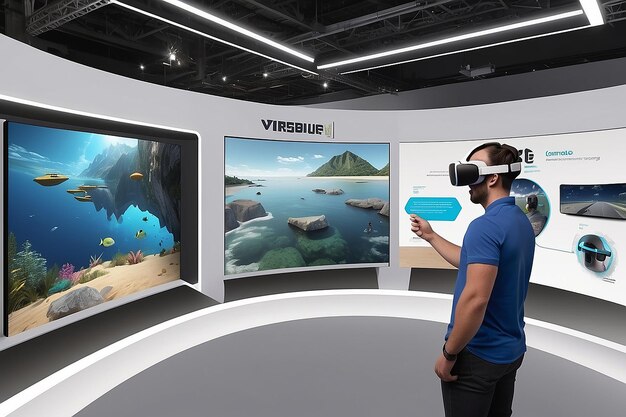
Revolutionize Sales: Harnessing Virtual Reality for Product Demonstrations
In today's fiercely competitive market, simply showcasing a product isn't enough. Businesses need to create an unforgettable, impactful experience that resonates deeply with potential customers. This is where the power of virtual reality for product demonstrations emerges as a game-changer. Imagine transporting your audience directly into an interactive world where they can not only see but experience your product in a fully immersive 3D environment, regardless of their physical location. This innovative approach transcends traditional sales pitches, offering unparalleled engagement and a distinct competitive advantage in the digital age.
The Unrivaled Power of Immersive Product Experience
Traditional product demonstrations often fall short in conveying the true essence, scale, or functionality of complex products. Flat images, static videos, or even physical prototypes have inherent limitations. Virtual reality shatters these barriers, providing an immersive product experience that engages multiple senses and fosters a deeper connection. With VR, customers aren't just passive observers; they become active participants, exploring every detail, interacting with features, and truly understanding the value proposition in a way no other medium can replicate.
This shift from passive viewing to active participation is crucial for modern sales and marketing. When a potential buyer can virtually walk around a new car model, customize its interior, or even "test drive" it in a simulated environment, their understanding and emotional connection to the product skyrocket. This level of interaction significantly enhances the customer journey, leading to more informed decisions and higher conversion rates.
Beyond Visualization: Interactive Showcases and Digital Twins
- Interactive Showcases: VR transforms static product displays into dynamic, interactive showcases. Users can manipulate products, change colors, toggle features, or even disassemble complex machinery to understand its inner workings. This level of interactivity is particularly valuable for B2B sales of high-value equipment or intricate systems.
- Digital Twins: For highly complex or large-scale products (e.g., industrial machinery, architectural designs, aerospace components), VR enables the creation of precise digital twins. These virtual replicas allow stakeholders to inspect, test, and even train on a product long before a physical prototype exists, significantly reducing development costs and time-to-market.
- Remote Accessibility: One of the most significant benefits is the ability to conduct global product demonstrations without the need for expensive travel or logistical nightmares. A sales team can virtually present a new product to clients across continents, offering the same high-quality, interactive experience as an in-person meeting. This capability is vital for remote sales strategies.
Strategic Advantages of Adopting VR in Sales and Marketing
Embracing virtual reality for product demonstrations isn't merely about adopting new technology; it's about gaining a strategic edge that impacts the entire sales funnel. The benefits extend beyond novelty, touching core aspects of customer engagement, sales efficiency, and brand perception.
Enhanced Customer Engagement and Retention
The novelty and interactive nature of VR inherently lead to higher customer engagement. Users are more likely to spend extended periods exploring a product in VR compared to traditional methods. This deeper engagement translates into a better understanding of the product's benefits and features, reducing post-purchase dissonance and fostering long-term customer loyalty. When customers feel truly connected to a product before purchase, their satisfaction levels are demonstrably higher.
Moreover, VR demonstrations are memorable. They create a lasting impression that differentiates your brand from competitors. This experiential marketing approach positions your company as innovative and forward-thinking, enhancing your overall brand storytelling and market perception.
Cost Efficiency and Scalability
While the initial investment in VR development might seem significant, the long-term cost savings are substantial. Consider the expenses associated with shipping physical prototypes, setting up elaborate showrooms, or sending sales teams on extensive travel for in-person demos. VR eliminates many of these costs. A single VR application can be replicated and deployed globally, offering unparalleled scalability.
For instance, an automotive company can launch a new model globally without manufacturing hundreds of physical prototypes for dealerships worldwide. Architects can present complex building designs to clients without needing to construct expensive physical models. This efficiency streamlines the sales process and frees up resources for other strategic initiatives.
Accelerated Sales Cycles and Higher Conversion Rates
By providing a complete and interactive understanding of a product, VR demonstrations can significantly shorten the sales cycle. Prospects gain all the necessary information and experience within the virtual environment, reducing the need for multiple follow-up meetings or extensive Q&A sessions. The clarity and confidence instilled by an immersive experience often lead to quicker decision-making.
Furthermore, the emotional connection forged through an immersive VR experience often translates directly into higher conversion rates. When customers can visualize themselves using the product and understand its benefits on a visceral level, they are far more likely to commit to a purchase. This direct impact on the bottom line makes virtual reality for product demonstrations a powerful sales enablement tool.
Implementing VR Product Demos: Key Considerations and Best Practices
Successfully integrating VR into your sales strategy requires careful planning and execution. It's not just about building a VR experience; it's about building one that aligns with your business objectives and delivers genuine value to your target audience.
Defining Your Objectives and Target Audience
- Clear Goals: What do you want to achieve with your VR demo? Is it lead generation, accelerating sales, enhancing brand perception, or product training? Your objectives will dictate the scope and features of the VR experience.
- Audience Understanding: Who are you trying to reach? Their technical proficiency, access to VR hardware, and specific pain points will influence the design and delivery method of your VR demonstration. For example, a B2B client might require a highly detailed, functional simulation, while a B2C customer might prefer a more engaging, simplified experience.
Content Creation and Technical Considerations
The quality of your 3D assets is paramount. High-fidelity models, realistic textures, and accurate physics simulations are crucial for creating a convincing and effective VR experience. This often involves leveraging existing CAD files or creating new 3D models from scratch.
- Hardware Accessibility: Consider whether your target audience has access to high-end VR headsets (e.g., Meta Quest Pro, HTC Vive Pro 2) or if a more accessible solution like mobile VR (via Google Cardboard or similar) or web-based VR (WebXR) is more appropriate. The choice of hardware impacts the graphical fidelity and complexity of your demo.
- User Interface (UI) and Experience (UX) Design: A seamless and intuitive UI/UX is critical. Users should be able to navigate the virtual environment, interact with products, and access information effortlessly. Avoid complex controls or confusing layouts that could detract from the experience.
- Scalability and Updates: Plan for future updates and scalability. Can new product variations or features be easily integrated into the existing VR experience? A modular design approach can save significant development time and cost in the long run.
Integration with Sales and Marketing Workflows
To maximize impact, your VR product demonstrations should be seamlessly integrated into your existing sales and marketing workflows. This means considering:
- Sales Training: Equip your sales team with the knowledge and skills to effectively use the VR demo. They should understand its features, benefits, and how to guide prospects through the experience.
- Event Integration: Utilize VR at trade shows, conferences, and corporate events to draw crowds and create memorable interactions. Dedicated VR stations can become powerful magnets for potential leads.
- Lead Capture: Implement mechanisms within the VR experience or immediately afterward to capture lead information. This could be a virtual sign-up form or a direct link to a sales representative.
- Analytics: Track user interactions within the VR environment. Which features did they explore most? How long did they spend on certain aspects? This data provides invaluable insights for optimizing both the product and the demo itself, contributing to better sales enablement strategies.
Future Outlook: The Evolution of Virtual Reality in Business
The adoption of virtual reality for product demonstrations is only the beginning. As VR technology continues to mature, becoming more accessible and sophisticated, its role in business operations will expand significantly. We're moving towards a future where virtual showrooms are commonplace, and experiential marketing is the norm.
Expect to see greater convergence with artificial intelligence (AI) and augmented reality (AR). AI-powered virtual sales assistants could guide customers through VR demos, answering questions in real-time. AR could overlay digital product information onto the real world, blending virtual and physical product interactions. The concept of brand storytelling will evolve, allowing companies to create entirely new narratives around their products within immersive digital spaces.
Businesses that invest in VR now are not just adopting a new tool; they are future-proofing their sales and marketing strategies, positioning themselves at the forefront of digital transformation and ensuring they remain competitive in an increasingly virtual world. This proactive approach will be critical for long-term success in the evolving landscape of marketing innovation.
Frequently Asked Questions
What is virtual reality for product demonstrations?
Virtual reality for product demonstrations refers to the use of immersive VR technology to showcase products or services in a simulated, interactive 3D environment. Instead of viewing a product through images or videos, users wear a VR headset and are transported into a virtual space where they can explore, interact with, and experience the product as if it were physically present. This provides a deep, engaging, and comprehensive understanding of the product's features, scale, and functionality, often leading to a more impactful presentation than traditional methods.
How can VR improve the sales process?
VR significantly improves the sales process by offering an unparalleled level of customer engagement and understanding. It allows potential buyers to interact with a product in ways impossible with static media, leading to a stronger emotional connection and a clearer grasp of its value. This often results in faster decision-making, reduced sales cycles, and higher conversion rates. Additionally, VR enables global product showcases without travel costs, making remote sales more effective and scalable, and provides valuable analytics on user interaction for further optimization.
What types of products benefit most from VR demonstrations?
Products that are complex, large, expensive, customizable, or difficult to transport for physical demonstrations benefit most from virtual reality for product demonstrations. This includes, but is not limited to:
- Automobiles and heavy machinery: Allowing users to explore interiors, customize features, or even "operate" equipment.
- Real estate and architecture: Offering virtual tours of properties or unbuilt designs.
- Industrial equipment: Demonstrating intricate internal mechanisms or operational procedures safely.
- High-tech gadgets: Showcasing complex user interfaces and functionalities.
- Luxury goods: Creating an exclusive, premium immersive product experience.

0 Komentar