
Unlocking Tomorrow: Comprehensive Applications of Quantum Computing and Quantum Sensors
The dawn of a new technological era is upon us, driven by the profound principles of quantum mechanics. At the forefront of this revolution are two intertwined powerhouses: quantum computing and quantum sensors. These groundbreaking technologies are not just theoretical constructs; they are rapidly moving from laboratories to real-world deployment, promising to redefine industries and solve some of humanity's most complex challenges. This comprehensive guide delves deep into the fascinating world of quantum computing quantum sensors applications, exploring how their synergistic capabilities are paving the way for unprecedented advancements in fields as diverse as healthcare, defense, navigation, and fundamental science. Prepare to discover the transformative potential of quantum technology, engineered for precision and powered by the very fabric of reality.
The Quantum Leap: Understanding Quantum Computing and Quantum Sensors
Before we explore their myriad applications, it's crucial to grasp the fundamental nature of these quantum marvels. Quantum computing harnesses phenomena like superposition and quantum entanglement to process information in ways classical computers cannot. Instead of binary bits (0s or 1s), quantum computers use qubits, which can represent 0, 1, or both simultaneously, exponentially increasing processing power for specific types of problems. This enables them to tackle calculations previously deemed impossible, from complex simulations to optimization problems.
Conversely, quantum sensors leverage the extreme sensitivity of quantum states to measure physical quantities with unparalleled accuracy. Unlike traditional sensors that are limited by classical noise, quantum sensors exploit quantum coherence and entanglement to achieve levels of precision that defy conventional limits. They detect minute changes in magnetic fields, gravity, time, temperature, and more, opening doors to new forms of perception and measurement. This field, often referred to as quantum metrology, is at the heart of many revolutionary applications.
The Symbiotic Relationship: How They Complement Each Other
While distinct, quantum computing and quantum sensors often work in tandem. Quantum computers can process the vast and intricate data streams generated by highly sensitive quantum sensors, extracting insights that would overwhelm classical systems. Conversely, quantum sensors can be used to characterize and calibrate the delicate quantum states within quantum computers, aiding in their development and error correction. This symbiotic relationship accelerates progress in both domains, creating a powerful ecosystem for innovation.
- Data Processing: Quantum computers excel at analyzing complex datasets, making them ideal for processing the high-fidelity outputs of advanced quantum sensors.
- System Calibration: Quantum sensors can monitor and control the quantum states of qubits, essential for maintaining coherence and reducing errors in quantum computing platforms.
- Algorithm Development: New quantum algorithms can be designed to optimize sensor performance or interpret sensor data more effectively.
Revolutionary Applications of Quantum Sensors Across Industries
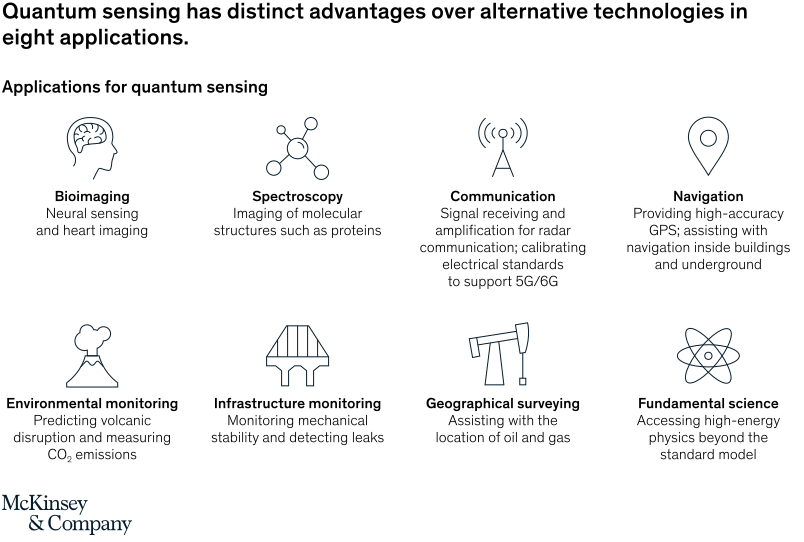
The sheer precision offered by quantum sensors is unlocking capabilities previously confined to science fiction. Their applications span critical sectors, promising to enhance our understanding of the world and improve our daily lives.
1. Healthcare and Medical Diagnostics
The impact of quantum sensors in medicine is nothing short of transformative, offering non-invasive, highly sensitive diagnostic tools.
- Enhanced Medical Imaging: Quantum magnetometers, particularly those based on nitrogen-vacancy (NV) centers in diamond, are being developed to improve the resolution and sensitivity of MRI (Magnetic Resonance Imaging) scans. This could lead to earlier detection of diseases like cancer and neurological disorders by identifying subtle changes in biological systems.
- Non-Invasive Brain Activity Monitoring: Optically pumped magnetometers (OPMs) can detect the tiny magnetic fields generated by brain activity, offering a more portable and less cumbersome alternative to traditional magnetoencephalography (MEG) for studying epilepsy, Parkinson's disease, and other neurological conditions.
- Drug Discovery and Development: Quantum sensors can precisely characterize molecular structures and interactions, accelerating the process of designing new drugs and therapies. They can detect the subtle magnetic signatures of molecules, providing unprecedented insights into their properties and how they bind to targets.
- Precision Surgery: Imagine surgical tools guided by quantum sensors, allowing surgeons to differentiate between healthy and diseased tissue with microscopic accuracy, minimizing damage to surrounding areas.
2. Navigation, Timing, and Geodesy
Precision timing and navigation are foundational for modern society. Quantum sensors are poised to provide unparalleled accuracy, reducing reliance on vulnerable systems like GPS.
- GPS-Independent Navigation: Quantum accelerometers and gravimeters can provide highly accurate positional data without external signals. This is crucial for defense applications, autonomous vehicles operating in GPS-denied environments, and long-duration underwater missions. By measuring changes in gravity and acceleration with extreme sensitivity, they can precisely track movement over extended periods.
- Ultra-Precise Timekeeping: Atomic clocks, the epitome of quantum metrology, are the most accurate timekeeping devices known. Next-generation optical atomic clocks are so precise they lose less than one second in billions of years. These clocks are vital for synchronizing global communication networks, financial transactions, and advanced scientific experiments, serving as the backbone for modern infrastructure. Learn more about the future of timekeeping.
- Geophysical Exploration and Mapping: Quantum gravimeters can detect minute variations in the Earth's gravitational field, allowing for detailed mapping of underground structures. This has significant implications for oil and gas exploration, mineral detection, and monitoring geological shifts that could indicate seismic activity. They can also aid in detecting hidden tunnels or voids beneath the surface.
3. Defense and Security
The strategic advantages offered by quantum sensors are immense, enhancing capabilities in surveillance, communication, and threat detection.
- Stealth Detection: Quantum magnetometers can potentially detect stealth aircraft and submarines by identifying tiny magnetic anomalies they create, even when other detection methods fail.
- Secure Communication: While quantum communication primarily relies on quantum entanglement for secure key distribution, quantum sensors can play a role in optimizing the quantum channels and detecting eavesdropping attempts by monitoring quantum states.
- Underwater Navigation: Quantum gravimeters and accelerometers can provide highly accurate navigation for submarines, independent of surface-based GPS signals, crucial for covert operations.
- Threat Identification: Advanced quantum sensors could be used to detect chemical, biological, or nuclear threats with unprecedented sensitivity and speed, providing early warning capabilities.
4. Materials Science and Fundamental Research
Quantum sensors are indispensable tools for probing the fundamental properties of matter and pushing the boundaries of scientific discovery.
- Characterizing Novel Materials: Scientists use quantum sensors, particularly NV centers in diamond, to image and understand the magnetic and electronic properties of new materials at the nanoscale. This is critical for developing next-generation electronics, superconductors, and quantum computing hardware itself.
- Probing Fundamental Physics: Quantum sensors are at the forefront of experiments designed to detect dark matter, search for gravitational waves, and test the fundamental laws of physics. Their extreme sensitivity allows scientists to observe phenomena previously undetectable, opening new avenues for understanding the universe.
- Environmental Monitoring: Highly sensitive quantum sensors can detect extremely low concentrations of pollutants or greenhouse gases, providing invaluable data for environmental protection and climate change research.
The Role of Quantum Computing in Enhancing Sensor Data
While quantum sensors gather incredibly precise data, the sheer volume and complexity of this information can overwhelm classical computing systems. This is where quantum computing steps in, offering a powerful complement.
Advanced Data Analysis and Pattern Recognition
Quantum algorithms are uniquely suited for certain types of data analysis that are intractable for classical computers. For instance, quantum machine learning algorithms could process sensor data from multiple sources (e.g., medical imaging, environmental sensors, geophysical surveys) to identify subtle patterns or anomalies that indicate disease, environmental shifts, or hidden structures. This could lead to:
- Accelerated Diagnostics: Rapid analysis of quantum sensor data to provide quicker and more accurate medical diagnoses.
- Improved Predictive Models: Building more robust models for weather forecasting, climate change, or geological events by ingesting and processing vast sensor networks.
- Enhanced Signal Processing: Differentiating true signals from noise in extremely complex data streams, improving the reliability of sensor readings in challenging environments.
Optimization and Calibration of Quantum Systems
Quantum computers can also be used to optimize the design and operation of quantum sensors themselves. They can simulate complex quantum interactions to fine-tune sensor parameters, improve coherence times, and develop more robust sensor architectures. This iterative feedback loop between quantum sensing and quantum computing accelerates the development of both technologies.
- Sensor Design Optimization: Simulating quantum materials and interactions to design more sensitive and stable quantum sensors.
- Error Mitigation: Developing quantum error correction codes that can be applied to sensor data, ensuring the integrity of the ultra-precise measurements.
- Complex System Control: Managing and controlling large arrays of quantum sensors, ensuring their synchronized operation and data fusion.
Actionable Insights and Future Outlook
The synergy between quantum computing and quantum sensors represents a paradigm shift with profound implications for industries worldwide. Businesses, researchers, and policymakers must prepare for this transformative wave.
- Invest in R&D: Companies should allocate resources to explore how quantum sensing and computing can revolutionize their core operations, from developing new products to optimizing existing processes.
- Foster Collaboration: The complexity of quantum technologies necessitates interdisciplinary collaboration between physicists, engineers, computer scientists, and industry experts.
- Talent Development: There's a growing need for skilled professionals in quantum information science. Investing in education and training programs is critical to building the future quantum workforce.
- Pilot Programs: Consider implementing small-scale pilot projects to test the feasibility and benefits of quantum sensor applications within your specific domain. Early adoption can provide a significant competitive advantage.
- Ethical Considerations: As with any powerful technology, proactive consideration of ethical implications, data privacy, and security is paramount to ensure responsible development and deployment.
The journey into the quantum realm is just beginning, and the pace of innovation is accelerating. Staying informed and strategically engaging with these technologies will be crucial for navigating the future landscape. For more detailed information on specific quantum technologies, consider exploring resources on quantum optics or cold atom physics, which underpin many sensor designs.
Frequently Asked Questions
What is the primary advantage of quantum sensors over classical sensors?
The primary advantage of quantum sensors lies in their unparalleled sensitivity and precision, stemming from their ability to exploit quantum mechanical phenomena like superposition and quantum entanglement. Unlike classical sensors limited by noise and fundamental physical limits, quantum sensors can detect incredibly subtle changes in physical quantities (e.g., magnetic fields, gravity, time) that are beyond the capabilities of conventional technologies. This enables breakthroughs in fields requiring extreme accuracy, such as medical imaging, precise navigation, and fundamental scientific research, significantly enhancing our perception of the world.
How do quantum sensors contribute to medical advancements?
Quantum sensors are revolutionizing medical advancements by enabling earlier, more accurate, and less invasive diagnostics. For instance, they can enhance MRI resolution for detecting early-stage diseases, precisely measure neural activity in the brain for neurological disorder diagnosis (using quantum magnetometers), and provide detailed insights into molecular structures for accelerated drug discovery. Their ability to sense minute changes at the cellular or molecular level opens new avenues for personalized medicine and targeted therapies, improving patient outcomes and quality of life.
Can quantum sensors replace GPS for navigation?
While not a direct replacement for all GPS functions, quantum sensors, particularly quantum accelerometers and gravimeters, offer a highly promising alternative for GPS-independent navigation. They can provide extremely accurate positional data by precisely measuring inertial forces and local gravitational fields, allowing for navigation in environments where GPS signals are unavailable or unreliable (e.g., underwater, underground, or in contested airspace). This capability is crucial for defense, autonomous vehicles, and long-duration missions, significantly enhancing navigational resilience and precision without relying on external signals.

0 Komentar